| Vorheriges Thema anzeigen :: Nächstes Thema anzeigen |
| Autor |
Nachricht |
RokkorDoctor 


Anmeldungsdatum: 27.11.2021
Beiträge: 1562
Wohnort: Kent, UK
Expire: 2025-05-01
|
 Verfasst am: Mo Jul 04, 2022 1:40 pm Titel: Lenses with distortion control? |
|
Verfasst am: Mo Jul 04, 2022 1:40 pm Titel: Lenses with distortion control? |
|
|
RokkorDoctor wrote:
These days it is easy(ier) to correct for pincushion or barrel distortion in PP.
I have no darkroom/printing experience, but I was wondering if anyone ever made any enlarger lenses/accessories that allowed for distortion correction prior to digital PP.
More specifically, does anyone know of a lens that had a degree of distortion control?
E.g. Minolta had their ROKKOR 24mm/2.8 VFC and ROKKOR SHIFT CA 35mm/2.8 that both had a degree of control over field curvature. I was wondering if there were ever any lenses of any make thad had a degree of distortion control in similar vein? (expecting the answer to be no.) I'm thinking fixed focal length purpose-designed here, not the usual shift from barrel to pincushion distortion as seen in zoom lenses...
_________________
Mark
SONY A7S, A7RII + dust-sealed modded Novoflex/Fotodiox/Rayqual MD-NEX adapters
Minolta SR-1, SRT-101/303, XD7/XD11, XGM, X700
Bronica SQAi
Ricoh GX100
Minolta majority of all Rokkor SR/AR/MC/MD models made
Sigma 14mm/3.5 for SR mount
Tamron SP 60B 300mm/2.8 (Adaptall)
Samyang T-S 24mm/3.5 (Nikon mount, DIY converted to SR mount)
Schneider-Kreuznach PC-Super-Angulon 28mm/2.8 (SR mount)
Bronica PS 35/40/50/65/80/110/135/150/180/200/250mm |
|
| Nach oben |
|
 |
Gerald
Anmeldungsdatum: 25.03.2014
Beiträge: 1292
Wohnort: Brazil
|
Verfasst am: Di Jul 05, 2022 12:58 pm Titel: |
|
Verfasst am: Di Jul 05, 2022 12:58 pm Titel: |
|
|
Gerald wrote:
I am unaware of the existence of a lens in which the designers provided for deliberate distortion control. Lens distortion is remarkably resistant to moderate variations in lens parameters, such as the spacing between optical elements. Distortion is not something that lens designers want to "control". They want to kill distortion! Unfortunately, completely eliminating distortion from a lens, except in special cases of symmetrical lenses working at 1:1 magnification, is an extremely difficult task. As a general rule, wide-angle lenses suffer from barrel distortion, while telephoto lenses suffer from pincushion distortion.
It is interesting to note that if a lens is used to project the image captured by that same lens, the distortion can be completely removed! For example, if the same lens used to capture the image is used in an enlarger to print the photo, the distortion disappears. Likewise, in principle a fisheye lens with 180 degree coverage could be used to project a distortion-free image of an entire hemisphere, provided the projection surface is dome-shaped.
_________________
If raindrops were perfect lenses, the rainbow did not exist. |
|
| Nach oben |
|
|
RokkorDoctor
Anmeldungsdatum: 27.11.2021
Beiträge: 1562
Wohnort: Kent, UK
Expire: 2025-05-01
|
Verfasst am: Di Jul 05, 2022 1:49 pm Titel: |
|
Verfasst am: Di Jul 05, 2022 1:49 pm Titel: |
|
|
RokkorDoctor wrote:
| Gerald hat folgendes geschrieben:: |
I am unaware of the existence of a lens in which the designers provided for deliberate distortion control. Lens distortion is remarkably resistant to moderate variations in lens parameters, such as the spacing between optical elements. Distortion is not something that lens designers want to "control". They want to kill distortion! Unfortunately, completely eliminating distortion from a lens, except in special cases of symmetrical lenses working at 1:1 magnification, is an extremely difficult task. As a general rule, wide-angle lenses suffer from barrel distortion, while telephoto lenses suffer from pincushion distortion.
It is interesting to note that if a lens is used to project the image captured by that same lens, the distortion can be completely removed! For example, if the same lens used to capture the image is used in an enlarger to print the photo, the distortion disappears. Likewise, in principle a fisheye lens with 180 degree coverage could be used to project a distortion-free image of an entire hemisphere, provided the projection surface is dome-shaped. |
I figured outside of the darkroom there would be little call for it. 
The idea of using the same lens in the enlarger as was used for taking the image is an interesting one; I hadn't thought of that.
If memory serves me right (I could be wrong), I recall reading somewhere that the choice of placement of the aperture in an optical system has an impact on distortion; I was thinking that maybe distortion could be varied by moving the aperture back and forth (space permitting). Not sure how much impact that would have though...
Possibly one could imagine a lens specifically designed with very significant residual aberrations (e.g. huge coma), and then to be used at a small aperture to control most of those aberrations (diffraction permitting), but with an aperture of adjustable position to change the distortion?
This is all in theory; you are likely correct that there would be little interest in such a lens, but I just wondered if any such lenses ever existed; it wouldn't be the first time an optics manufacturer tried something unusual without knowing whether it would catch on
_________________
Mark
SONY A7S, A7RII + dust-sealed modded Novoflex/Fotodiox/Rayqual MD-NEX adapters
Minolta SR-1, SRT-101/303, XD7/XD11, XGM, X700
Bronica SQAi
Ricoh GX100
Minolta majority of all Rokkor SR/AR/MC/MD models made
Sigma 14mm/3.5 for SR mount
Tamron SP 60B 300mm/2.8 (Adaptall)
Samyang T-S 24mm/3.5 (Nikon mount, DIY converted to SR mount)
Schneider-Kreuznach PC-Super-Angulon 28mm/2.8 (SR mount)
Bronica PS 35/40/50/65/80/110/135/150/180/200/250mm |
|
| Nach oben |
|
|
DConvert

Anmeldungsdatum: 12.06.2010
Beiträge: 984
Wohnort: Essex UK
|
Verfasst am: Di Jul 05, 2022 5:25 pm Titel: |
|
Verfasst am: Di Jul 05, 2022 5:25 pm Titel: |
|
|
DConvert wrote:
I've never heard of anything like that with enlarger lenses, but I remember hearing of a macro lens with adjustable field curvature...
In the dark room you're typically imaging one flat plane onto another, so I'd think macro is far more likely to want adjustments. |
|
| Nach oben |
|
|
kds315*


Anmeldungsdatum: 12.03.2008
Beiträge: 16912
Wohnort: Kehl, Germany
Expire: 2021-03-09
|
Verfasst am: Mi Jul 06, 2022 11:38 am Titel: |
|
Verfasst am: Mi Jul 06, 2022 11:38 am Titel: |
|
|
kds315* wrote:
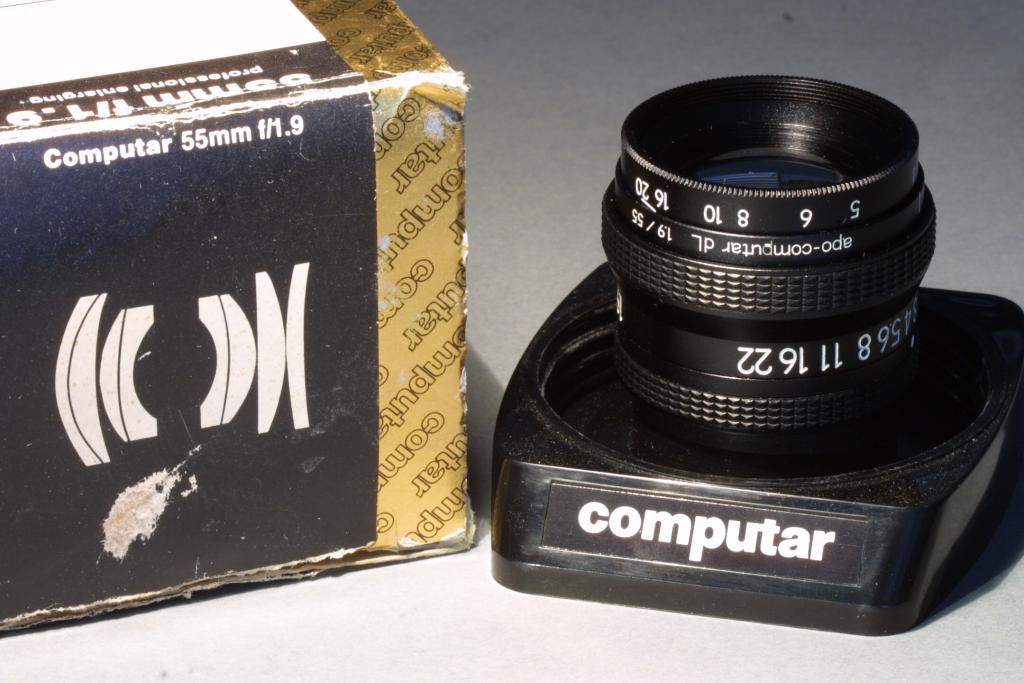
There was one, very rare, actually I have it in my collection, the Apo-Computar 1.9/50mm. It has a feature to manually adjust spherical correction depending on magnification using a floating element. But no distortion correction...
http://www.macrolenses.de/ml_detail.php?ObjektiveNr=192
_________________
Klaus - Admin
"S'il vient a point, me souviendra" [Thomas Bohier (1460-1523)]
http://www.macrolenses.de for macro and special lens info
http://www.pbase.com/kds315/uv_photos for UV Images and lens/filter info
https://www.flickr.com/photos/kds315/albums my albums using various lenses
http://photographyoftheinvisibleworld.blogspot.com/ my UV BLOG
http://www.travelmeetsfood.com/blog Food + Travel BLOG
https://galeriafotografia.com Architecture + Drone photography
Currently most FAV lens(es):
X80QF f3.2/80mm
Hypergon f11/26mm
ELCAN UV f5.6/52mm
Zeiss UV-Planar f4/60mm
Zeiss UV-Planar f2/62mm
Lomo Уфар-12 f2.5/41mm
Lomo Зуфар-2 f4.0/350mm
Lomo ZIKAR-1A f1.2/100mm
Nikon UV Nikkor f4.5/105mm
Zeiss UV-Sonnar f4.3/105mm
CERCO UV-VIS-NIR f1.8/45mm
CERCO UV-VIS-NIR f4.1/94mm
CERCO UV-VIS-NIR f2.8/100mm
Steinheil Quarzobjektiv f1.8/50mm
Pentax Quartz Takumar f3.5/85mm
Carl Zeiss Jena UV-Objektiv f4/60mm
NYE OPTICAL Lyman-Alpha II f1.1/90mm
NYE OPTICAL Lyman-Alpha I f2.8/200mm
COASTAL OPTICS f4/60mm UV-VIS-IR Apo
COASTAL OPTICS f4.5/105mm UV-Micro-Apo
Pentax Ultra-Achromatic Takumar f4.5/85mm
Pentax Ultra-Achromatic Takumar f5.6/300mm
Rodenstock UV-Rodagon f5.6/60mm + 105mm + 150mm
|
|
| Nach oben |
|
|
calvin83

Anmeldungsdatum: 12.04.2009
Beiträge: 7740
Wohnort: Hong Kong
|
Verfasst am: Mi Jul 06, 2022 12:29 pm Titel: |
|
Verfasst am: Mi Jul 06, 2022 12:29 pm Titel: |
|
|
calvin83 wrote:
A liquid lens array can do the job. Take a look at the following paper if you are interested.

_________________
The best lens is the one you have with you.
https://lensfever.com/
https://www.instagram.com/_lens_fever/ |
|
| Nach oben |
|
|
eggplant

Anmeldungsdatum: 27.05.2020
Beiträge: 517
|
Verfasst am: Mi Jul 06, 2022 12:34 pm Titel: |
|
Verfasst am: Mi Jul 06, 2022 12:34 pm Titel: |
|
|
eggplant wrote:
Some of the MS-OPTICS lenses have controls for various aberrations, but not distortion.
I have often wondered if it would be possible to design a Fisheye to rectilinear zoom, or maybe a dual focal length lens. I am sure it is possible, just not a market for it.
I am also more broadly sure you could make a group that changes distortion characteristics without others, however saying this I'm not sure how distortion might be intrinsic to other aberrations / glass shapes etc.
This won't count, but it's worth mentioning that the achromatic closeup lenses I've tried naturally add pincushion distortion, to the point of either neutralising barrel distortion of a prime or changing it to pincushion distortion.
Alot of the more powerful (4D+) ones I've tried swap it to pincushion distortion, but I have gotten lucky in completely neutralising the barrel distortion before.
They add some field curvature and edges might struggle to sharpen up on some powerful ones pulled from zoom lenses, but I find this to be nitpicking when even shit ones I've tried can be extremely sharp for 2/3rds of the frame stopped down. This was doing a flat field test which is abit harsh, in the field they are excellent.
They are a million times better than reversing or extension- I've tried.
My Leitz Elpro 1 (4D~) doesn't have these issues much at all, only £5. |
|
| Nach oben |
|
|
RokkorDoctor
Anmeldungsdatum: 27.11.2021
Beiträge: 1562
Wohnort: Kent, UK
Expire: 2025-05-01
|
Verfasst am: Mi Jul 06, 2022 1:00 pm Titel: |
|
Verfasst am: Mi Jul 06, 2022 1:00 pm Titel: |
|
|
RokkorDoctor wrote:
| kds315* hat folgendes geschrieben:: |
There was one, very rare, actually I have it in my collection, the Apo-Computar 1.9/50mm. It has a feature to manually adjust spherical correction depending on magnification using a floating element. But no distortion correction...
http://www.macrolenses.de/ml_detail.php?ObjektiveNr=192
|
Interesting.
It is not entirely clear what they refer to with "spherical correction". Do they mean spherical aberration or field curvature, or maybe both?
Minolta had 3 MF lenses with aberration control (24mm/2.8 VFC & 35mm/2.8 SHIFT CA for field curvature, 85mm/2.8 Varisoft for spherical aberration). It doesn't surprise me that other lenses with similar controls also existed, especially portrait lenses with adjustable spherical aberration, but the enlarger/macro Computar 55/1.9 you mentioned also makes sense.
_________________
Mark
SONY A7S, A7RII + dust-sealed modded Novoflex/Fotodiox/Rayqual MD-NEX adapters
Minolta SR-1, SRT-101/303, XD7/XD11, XGM, X700
Bronica SQAi
Ricoh GX100
Minolta majority of all Rokkor SR/AR/MC/MD models made
Sigma 14mm/3.5 for SR mount
Tamron SP 60B 300mm/2.8 (Adaptall)
Samyang T-S 24mm/3.5 (Nikon mount, DIY converted to SR mount)
Schneider-Kreuznach PC-Super-Angulon 28mm/2.8 (SR mount)
Bronica PS 35/40/50/65/80/110/135/150/180/200/250mm |
|
| Nach oben |
|
|
RokkorDoctor
Anmeldungsdatum: 27.11.2021
Beiträge: 1562
Wohnort: Kent, UK
Expire: 2025-05-01
|
Verfasst am: Mi Jul 06, 2022 1:10 pm Titel: |
|
Verfasst am: Mi Jul 06, 2022 1:10 pm Titel: |
|
|
RokkorDoctor wrote:
| calvin83 hat folgendes geschrieben:: |
A liquid lens array can do the job. Take a look at the following paper if you are interested.
|
Thanks for pointing out that paper/research exists! 
I have now read the paper and I get how it works. They vary distortion by electronically selecting which part of the second (imperfect) lens is used to generate the second image. In essence that is not too different from what I suggested in my earlier post that choice of aperture position could be used likewise, as that could also be used to select how far the chief ray is away from the principal point of the lens/one of the lenses.
It would seem to me that their current experimental setup introduces significant amounts of other types of aberrations, but it is interesting to see that some research is being done in the area of distortion control.
_________________
Mark
SONY A7S, A7RII + dust-sealed modded Novoflex/Fotodiox/Rayqual MD-NEX adapters
Minolta SR-1, SRT-101/303, XD7/XD11, XGM, X700
Bronica SQAi
Ricoh GX100
Minolta majority of all Rokkor SR/AR/MC/MD models made
Sigma 14mm/3.5 for SR mount
Tamron SP 60B 300mm/2.8 (Adaptall)
Samyang T-S 24mm/3.5 (Nikon mount, DIY converted to SR mount)
Schneider-Kreuznach PC-Super-Angulon 28mm/2.8 (SR mount)
Bronica PS 35/40/50/65/80/110/135/150/180/200/250mm |
|
| Nach oben |
|
|
RokkorDoctor
Anmeldungsdatum: 27.11.2021
Beiträge: 1562
Wohnort: Kent, UK
Expire: 2025-05-01
|
Verfasst am: Mi Jul 06, 2022 1:18 pm Titel: |
|
Verfasst am: Mi Jul 06, 2022 1:18 pm Titel: |
|
|
RokkorDoctor wrote:
| eggplant hat folgendes geschrieben:: |
Some of the MS-OPTICS lenses have controls for various aberrations, but not distortion.
I have often wondered if it would be possible to design a Fisheye to rectilinear zoom, or maybe a dual focal length lens. I am sure it is possible, just not a market for it. |
I did mention I wasn't looking at zoom lenses! . But yes, given that zoom lenses tend to have pincushion distortion at the long end and barrel at the short end, one could wonder what the resulting optic would look like if distortion correction throughout the zoom range was abandoned entirely as an objective during the design; just get zero distortion at the long end and let barrel distortion be whatever results at the short end whilst purely focusing on reducing the other aberrations. Perhaps a "fisheye" to rectilinear zoom would be what naturally resulted then...
| eggplant hat folgendes geschrieben:: |
I am also more broadly sure you could make a group that changes distortion characteristics without others, however saying this I'm not sure how distortion might be intrinsic to other aberrations / glass shapes etc.
This won't count, but it's worth mentioning that the achromatic closeup lenses I've tried naturally add pincushion distortion, to the point of either neutralising barrel distortion of a prime or changing it to pincushion distortion.
Alot of the more powerful (4D+) ones I've tried swap it to pincushion distortion, but I have gotten lucky in completely neutralising the barrel distortion before.
They add some field curvature and edges might struggle to sharpen up on some powerful ones pulled from zoom lenses, but I find this to be nitpicking when even shit ones I've tried can be extremely sharp for 2/3rds of the frame stopped down. This was doing a flat field test which is abit harsh, in the field they are excellent.
They are a million times better than reversing or extension- I've tried.
My Leitz Elpro 1 (4D~) doesn't have these issues much at all, only £5. |
I agree that in the field achromatic close-up lenses work quite well. They also take virtually no space in the camera bag  . Outside macro work rarely involves shooting perfectly flat subjects, and the main subject tends to be somewhat central, so a bit of field curvature and slight loss of sharpness in the corners is rarely an issue then.
_________________
Mark
SONY A7S, A7RII + dust-sealed modded Novoflex/Fotodiox/Rayqual MD-NEX adapters
Minolta SR-1, SRT-101/303, XD7/XD11, XGM, X700
Bronica SQAi
Ricoh GX100
Minolta majority of all Rokkor SR/AR/MC/MD models made
Sigma 14mm/3.5 for SR mount
Tamron SP 60B 300mm/2.8 (Adaptall)
Samyang T-S 24mm/3.5 (Nikon mount, DIY converted to SR mount)
Schneider-Kreuznach PC-Super-Angulon 28mm/2.8 (SR mount)
Bronica PS 35/40/50/65/80/110/135/150/180/200/250mm |
|
| Nach oben |
|
|
Gerald
Anmeldungsdatum: 25.03.2014
Beiträge: 1292
Wohnort: Brazil
|
Verfasst am: Mi Jul 06, 2022 5:57 pm Titel: |
|
Verfasst am: Mi Jul 06, 2022 5:57 pm Titel: |
|
|
Gerald wrote:
A good article by Zeiss on lens distortion:
https://lenspire.zeiss.com/photo/app/uploads/2018/04/Article-Distortion-2009-EN.pdf
The truth is, with the development of digital photography, distortion is much less a problem than it was before. All modern cameras automatically correct native lens distortion by software.
_________________
If raindrops were perfect lenses, the rainbow did not exist. |
|
| Nach oben |
|
|
RokkorDoctor
Anmeldungsdatum: 27.11.2021
Beiträge: 1562
Wohnort: Kent, UK
Expire: 2025-05-01
|
Verfasst am: Mi Jul 06, 2022 7:39 pm Titel: |
|
Verfasst am: Mi Jul 06, 2022 7:39 pm Titel: |
|
|
RokkorDoctor wrote:
Interesting article. Although in the later bit about the "egg shaped heads" (pg. 21 & 22) Zeiss really ignores the elephant in the room by not talking about centres of perspective (I am reluctant to say they are wrong in their explanation ). Print the same image larger and get up closer to the print, and all that "egg-shaped-head wide-angle distortion" completely disappears...
| Gerald hat folgendes geschrieben:: |
| The truth is, with the development of digital photography, distortion is much less a problem than it was before. All modern cameras automatically correct native lens distortion by software. |
Yes, obviously!
That is why my original query was regarding the possible existence of distortion-control optics manufactured before the advent of digital photography, specifically if anything had been designed for use in enlarger systems to negate any distortion present in the image on the negative.
But you yourself already commented that for that purpose the original taking lens could be used in the enlarger.
_________________
Mark
SONY A7S, A7RII + dust-sealed modded Novoflex/Fotodiox/Rayqual MD-NEX adapters
Minolta SR-1, SRT-101/303, XD7/XD11, XGM, X700
Bronica SQAi
Ricoh GX100
Minolta majority of all Rokkor SR/AR/MC/MD models made
Sigma 14mm/3.5 for SR mount
Tamron SP 60B 300mm/2.8 (Adaptall)
Samyang T-S 24mm/3.5 (Nikon mount, DIY converted to SR mount)
Schneider-Kreuznach PC-Super-Angulon 28mm/2.8 (SR mount)
Bronica PS 35/40/50/65/80/110/135/150/180/200/250mm |
|
| Nach oben |
|
|
Gerald
Anmeldungsdatum: 25.03.2014
Beiträge: 1292
Wohnort: Brazil
|
Verfasst am: Mi Jul 06, 2022 8:23 pm Titel: |
|
Verfasst am: Mi Jul 06, 2022 8:23 pm Titel: |
|
|
Gerald wrote:
| RokkorDoctor hat folgendes geschrieben:: |
| ...in the later bit about the "egg shaped heads" (pg. 21 & 22) Zeiss really ignores the elephant in the room by not talking about centres of perspective (I am reluctant to say they are wrong in their explanation ). Print the same image larger and get up closer to the print, and all that "egg-shaped-head wide-angle distortion" completely disappears... |
I understand your point of view (no pun intended), but a lot of people consider "egg shaped heads" undesirable because they see the photo at an "incorrect" distance. I've also seen many photographers saying that the convergence of verticals in photos taken with a wide angle is a distortion of the lens...
On the other hand, some people might even like the distortion of a fisheye lens. This is a famous portrait of Picasso taken by American photographer Davis Douglas Duncan:

When Duncan showed him the photo, Picasso's eyes lit up and he said, "Now you're a real artist!" You know, Picasso was the master of distortions...
_________________
If raindrops were perfect lenses, the rainbow did not exist. |
|
| Nach oben |
|
|
RokkorDoctor
Anmeldungsdatum: 27.11.2021
Beiträge: 1562
Wohnort: Kent, UK
Expire: 2025-05-01
|
Verfasst am: Do Jul 07, 2022 9:12 am Titel: |
|
Verfasst am: Do Jul 07, 2022 9:12 am Titel: |
|
|
RokkorDoctor wrote:
| Gerald hat folgendes geschrieben:: |
| RokkorDoctor hat folgendes geschrieben:: |
| ...in the later bit about the "egg shaped heads" (pg. 21 & 22) Zeiss really ignores the elephant in the room by not talking about centres of perspective (I am reluctant to say they are wrong in their explanation ). Print the same image larger and get up closer to the print, and all that "egg-shaped-head wide-angle distortion" completely disappears... |
I understand your point of view (no pun intended), but a lot of people consider "egg shaped heads" undesirable because they see the photo at an "incorrect" distance. I've also seen many photographers saying that the convergence of verticals in photos taken with a wide angle is a distortion of the lens...
On the other hand, some people might even like the distortion of a fisheye lens. This is a famous portrait of Picasso taken by American photographer Davis Douglas Duncan:
When Duncan showed him the photo, Picasso's eyes lit up and he said, "Now you're a real artist!" You know, Picasso was the master of distortions... |
I have yet to see a "Picasso" lens that places both eyes on the same side of the nose
Zeiss were correct in suggesting that some of this "distortion" can be addressed by using a fish-eye lens. If the print is to be viewed from the likely normal viewing distance, then a carefully composed fish-eye shot (full-frame e.g. 16mm) can look more natural then one taken with a rectilinear extreme wide-angle lens. Especially the corners in a landscape shot where there are no obvious "man-made" straight lines visible can look more natural without the "stretched-out" look you get with a rectilinear wide-angle shot.
_________________
Mark
SONY A7S, A7RII + dust-sealed modded Novoflex/Fotodiox/Rayqual MD-NEX adapters
Minolta SR-1, SRT-101/303, XD7/XD11, XGM, X700
Bronica SQAi
Ricoh GX100
Minolta majority of all Rokkor SR/AR/MC/MD models made
Sigma 14mm/3.5 for SR mount
Tamron SP 60B 300mm/2.8 (Adaptall)
Samyang T-S 24mm/3.5 (Nikon mount, DIY converted to SR mount)
Schneider-Kreuznach PC-Super-Angulon 28mm/2.8 (SR mount)
Bronica PS 35/40/50/65/80/110/135/150/180/200/250mm |
|
| Nach oben |
|
|
|
|
|
Du kannst keine Beiträge in dieses Forum schreiben.
Du kannst auf Beiträge in diesem Forum nicht antworten.
Du kannst deine Beiträge in diesem Forum nicht bearbeiten.
Du kannst deine Beiträge in diesem Forum nicht löschen.
Du kannst an Umfragen in diesem Forum nicht mitmachen.
|
 Deutsch
 Español
 中文
 Magyar
 Русский
 日本語
 Français



