| Vorheriges Thema anzeigen :: Nächstes Thema anzeigen |
| Autor |
Nachricht |
Orio 

Anmeldungsdatum: 24.02.2007
Beiträge: 29545
Wohnort: West Emilia
Expire: 2012-12-04
|
 Verfasst am: So Okt 18, 2009 11:38 pm Titel: F/Stop scale with intermediate values |
|
Verfasst am: So Okt 18, 2009 11:38 pm Titel: F/Stop scale with intermediate values |
|
|
Orio wrote:
Here's a tentative of F/stop scale with intermediate values of (roughly) thirds of stop.
I calculated empirically and for some values, I used the common intermediate values used in cameras and lenses, which may not be full precise, so if more expert people notices mistakes please point out:
f/1
f/1.1
f/1.3
f/1.4
f/1.6
f/1.8
f/2
f/2.2
f/2.5 (should be f/2.6)
f/2.8
f/3.2
f/3.6
f/4
f/4.5 (should be f/4.4)
f/5
f/5.6
f/6.3 (should be f/6.4)
f/7.1 (should be f/7.2)
f/8
f/9
f/10
f/11 (should be f/11.2)
f/12.6
f/14.2
f/16
f/18
f/20
f/22
f/25.2
f/28.4
f/32
f/36
f/40
f/44
f/50.4
f/56.8
f/64
Note the discrepancy at f/11.2 from the common values on cameras and lenses (f/11)
Other commonly used values in lenses and cameras do not correspond to my calculations (f/2.5 instead of f/2.6, f/4.5 instead of f/4.4, f/6.3 instead of f/6.4 and f/7.1 instead of f/7.2)
_________________
Orio, Administrator
T*
NE CEDE MALIS AUDENTIOR ITO
Ferrania film is reborn! http://www.filmferrania.it/
Support the Ornano film chemicals company and help them survive!
http://forum.mflenses.com/ornano-chemical-products-t55525.html |
|
| Nach oben |
|
 |
sichko


Anmeldungsdatum: 20.06.2008
Beiträge: 2475
Wohnort: South West UK
|
Verfasst am: Mo Okt 19, 2009 7:23 am Titel: |
|
Verfasst am: Mo Okt 19, 2009 7:23 am Titel: |
|
|
sichko wrote:
Hi Orio - I'm sure that these values are adequate fo all practical purposes.
However there are one or two errors in the last places. The problem comes from rounding errors. So the common multiplier for whole stops is not 1.4 but 1.414 or 1.414213 or 1.414213562 or ... - in other words the square root of two - to as many places after the point as are needed. So 1.4 is an adequate approximation for 1.414....., 2.8 is OK for 2.828.... but the next one in this set is 5.656 wich we might round up to 5.7 rather than 5.6... and eventually 44 becomes 45.3. Of course the % error doesn't increase. The numbers just look worse. Anyway, for those who want them, here's an accurate set given to one decimal place (except for 1, 2, 4 etc which are perfect integers)..
1 2 4 8 16 32 64
1.2 2.2 4.5 9.0 18.0 35.9
1.3 2.5 5.0 10.1 20.2 40.3
1.4 2.8 5.7 11.3 22.6 45.3
1.6 3.2 6.3 12.7 25.4 50.8
1.8 3.6 7.1 14.3 28.5 57.0
_________________
John |
|
| Nach oben |
|
|
Arkku

Anmeldungsdatum: 28.02.2007
Beiträge: 1416
Wohnort: Helsinki, Finland
|
Verfasst am: Mo Okt 19, 2009 5:19 pm Titel: |
|
Verfasst am: Mo Okt 19, 2009 5:19 pm Titel: |
|
|
Arkku wrote:
To get the accurate values one can just use powers of the square root of 2; to increase the aperture by one stop increase the power by 1. So, for example, sqrt(2)^0 = 1, sqrt(2)^1 = 1.41…, sqrt(2)^2 = 2, sqrt(2)^3 = 2.82…, etc. To get the intermediate values, you can use fractional powers, e.g. sqrt(2)^½ = 1.18… (rounded to f/1.2).
The commonly displayed scale of values is rounded in a pretty strange manner, however, e.g. sqrt(2)^5 = 5.656… so f/5.6 would actually round to f/5.7, and sqrt(2)^9 = 22.62… so f/22 would round to f/23. If we accept that one should round down after two significant digits, the fractional values for half- and third-stop intervals become inconsistent with common usage. So, all-in-all, there's no well-defined way how the scale should be rounded. I've written an algorithm to produce scales at the desired intervals using complex rounding rules reasonably consistent with the commonly displayed scale. (The theoretical scale, that is—electronic cameras complicate things further by e.g. substituting values based on that manufacturer's lenses, or the lens currently mounted…)
Anyhow, here are the computer-generated scales (first the "typical" rounded f-stop, then the accurate value from sqrt(2)^AV, rounded to two decimal places).
In one-half stop increments:
| Code: |
AV f-stop
0 1 1
1/2 1.2 1.19
1 1.4 1.41
1/2 1.7 1.68
2 2 2
1/2 2.4 2.38
3 2.8 2.83
1/2 3.4 3.36
4 4 4
1/2 4.8 4.76
5 5.6 5.66
1/2 6.7 6.73
6 8 8
1/2 9.5 9.51
7 11 11.31
1/2 13 13.45
8 16 16
1/2 19 19.03
9 22 22.63
1/2 27 26.91
10 32 32
1/2 38 38.05
11 45 45.25
1/2 54 53.82
12 64 64
1/2 76 76.11
13 90 90.51
1/2 107 107.63
14 128 128
|
In one-third stop increments:
| Code: |
AV f-stop
0 1 1
1/3 1.1 1.12
2/3 1.3 1.26
1 1.4 1.41
1/3 1.6 1.59
2/3 1.8 1.78
2 2 2
1/3 2.2 2.24
2/3 2.5 2.52
3 2.8 2.83
1/3 3.2 3.17
2/3 3.6 3.56
4 4 4
1/3 4.5 4.49
2/3 5 5.04
5 5.6 5.66
1/3 6.3 6.35
2/3 7.1 7.13
6 8 8
1/3 9 8.98
2/3 10 10.08
7 11 11.31
1/3 13 12.70
2/3 14 14.25
8 16 16
1/3 18 17.96
2/3 20 20.16
9 22 22.63
1/3 25 25.40
2/3 28 28.51
10 32 32
1/3 36 35.92
2/3 40 40.32
11 45 45.25
1/3 51 50.80
2/3 57 57.02
12 64 64
1/3 72 71.84
2/3 80 80.63
13 90 90.51
1/3 101 101.59
2/3 114 114.04
14 128 128
|
(Edit: The typically displayed scale was probably obtained by taking f/1 and f/1.4 and repeatedly doubling them, i.e. those values ×2 are f/2 and f/2.8, those values ×2 are f/4 and f/5.6, etc. This is a good way to generate the whole f-stops as long as one remembers any two consecutive f-stops; double them to go forwards, halve them to go backwards. But when using powers one must use the square root of two, and not e.g. 1.4, or the integer stops will be off…)
Zuletzt bearbeitet von Arkku am Mo Okt 19, 2009 11:46 pm, insgesamt ein Mal bearbeitet |
|
| Nach oben |
|
|
hexi

Anmeldungsdatum: 01.07.2009
Beiträge: 1631
Wohnort: France
Expire: 2011-11-18
|
Verfasst am: Mo Okt 19, 2009 6:45 pm Titel: |
|
Verfasst am: Mo Okt 19, 2009 6:45 pm Titel: |
|
|
hexi wrote:
Uhhh well, its a bit complicated to me and i'm not a math fan... here what i have with the in between stops on the CZJ Sonnar 135mm
wide open : 3.5
then two stop between f5.6
i think its f4 and f5
f7 - f8 - f9 - f11 - f13.5 - f19 - f22
oh sounds strange but when metering light its very good, cause i have precision up to 1/3 light measure given, so hooray for between stops. anyway i take the closest, depending of mood 
_________________
Happy owner and user of :
SLR's > Contax Aria - RX
DSLR > Canon 5D
Lenses : C/Y Planar 1.4/50 - Distagon 2.8/35 - Planar 1.4/85
http://www.flickr.com/photos/sonnar85 |
|
| Nach oben |
|
|
sichko
Anmeldungsdatum: 20.06.2008
Beiträge: 2475
Wohnort: South West UK
|
Verfasst am: Di Okt 20, 2009 11:54 am Titel: |
|
Verfasst am: Di Okt 20, 2009 11:54 am Titel: |
|
|
sichko wrote:
If you wish to calculate the "number of stops", NOS, between two given aperture values, A & B, the equation is given by...
NOS = [log(A/B)]/log[square root of 2]
So for example, 5.6 & 4 gives us NOS = 0.97. The difference between 0.97 and "1" will be small for many purposes. Rounding up the exact value for the "stop near 5.6" reduces the absolute value of the error - but not by much. So, for 5.7 and 4 we get NOS=1.02.
For 11 & 8 NOS = 0.92 - if a tenth of a stop is important to you this error might be significant.
_________________
John |
|
| Nach oben |
|
|
Orio
Anmeldungsdatum: 24.02.2007
Beiträge: 29545
Wohnort: West Emilia
Expire: 2012-12-04
|
Verfasst am: Di Okt 20, 2009 1:26 pm Titel: |
|
Verfasst am: Di Okt 20, 2009 1:26 pm Titel: |
|
|
Orio wrote:
With film, 1/10th of a stop is irrelevant. There is no film so sensitive to respond to a change of 1/10th of a stop, except -perhaps- special film that used to be created for army.
With a digital sensors, I think it's more or less the same, except perhaps a computer could scan and find a 1/10th stop exposure difference. A human eye most certainly won't. 
_________________
Orio, Administrator
T*
NE CEDE MALIS AUDENTIOR ITO
Ferrania film is reborn! http://www.filmferrania.it/
Support the Ornano film chemicals company and help them survive!
http://forum.mflenses.com/ornano-chemical-products-t55525.html |
|
| Nach oben |
|
|
Arkku
Anmeldungsdatum: 28.02.2007
Beiträge: 1416
Wohnort: Helsinki, Finland
|
Verfasst am: Di Okt 20, 2009 5:05 pm Titel: |
|
Verfasst am: Di Okt 20, 2009 5:05 pm Titel: |
|
|
Arkku wrote:
| sichko hat folgendes geschrieben:: |
| So for example, 5.6 & 4 gives us NOS = 0.97. The difference between 0.97 and "1" will be small for many purposes. |
In practice the difference between f/4 and f/5.6 will be as close to 1 as manufacturing tolerances allow, however, since the displayed values are rounded for the user to see but not necessarily for the camera or lens itself…
In any case, a difference less than one third of a stop is generally insignificant for any use, and one must remember that various tolerances make it difficult to reach even this precision in exposure (e.g. ISO ratings are not exact, the aperture may not be perfectly calibrated, camera may be using shutter speeds as powers of two instead of what it displays, lens may have a t-stop different than f-stop due to loss of light in elements, focusing may cause bellows factor that's not accounted for in electronics especially with vintage lenses, etc).
Personally I have my DSLR set to work at one-half stop intervals for less turning of the dial and to better match the aperture ring on manual focus lenses (I've never seen a vintage lens with one-third clicks in the aperture ring, although obviously some lenses have a stepless aperture). |
|
| Nach oben |
|
|
estudleon


Anmeldungsdatum: 15.05.2008
Beiträge: 3754
Wohnort: Argentina
|
Verfasst am: Mi Apr 21, 2010 10:55 am Titel: |
|
Verfasst am: Mi Apr 21, 2010 10:55 am Titel: |
|
|
estudleon wrote:
I think that the paerture numbers are a compromise, and the blades positions are a bit different in each lens. You can see that reading the differents shutter speeds in the cams when metering using differents lenses and the "same" nominal aperture.
For example the S-M-C 1,4 nominal aperture is a T number 1,47 or so.
Rino.
_________________
Konica 2,8/100
CZJ: 4/20, 2,4/35, 1,8/50 aus jena, 3,5/135MC, Pentacon 1,8/50
Pentax S-M-C-1,4/50
Helios 44-3
Mamiya 2,8/135
Misc. : jupiter 9
Stuff used:
A) SRL
Alpa 10 D - kern macro Switar 1,9/50 -black, Kilffit apochromat 2/100.
Asahi pentax spotmatic super takumar 1,4/50
Contaflex super B tessar 2,8/50 Pro-tessar 115
Leica R3 electronic summicron 2/50 elmarit 2,8/35
Konica Autoreflex 3 (2 black and chrome one), TC, T4. 2,8/24, 3,5/28 not MC and MC, 1,8/40, 1,4/50, 1,7/50 MC and not MC, 1,8/85, 3,2/135, 3,5/135, 4/200
Minolta XG9 2,8/35, 2/45, 3,5/135
Nikkormat FTn 1,4/50, 2,8/135
Fujica ST 801, 605, 705n. 3,5/19, 1,4/50, 1,8/55, 4/85, 3,5/135.
Praktica MTL 5 and a lot of M42 lenses.
Voigtlander. Bessamatic m, bessamatix de luxe, bessamatic cs, ultramatic and ultramatic cs.
Skoparex 3,5/35, skopagon 2/40, skopar 2,8/50, skopar X 2,8/50, super lanthar (out of catalogue) 2,8/50, dinarex 3,4/90, dinarex 4,8/100, super dinarex 4/135, super dinarex 4/200, zoomar 2,8/36-83, portrait lens 0, 1 and 2. Curtagon 4/28 and 2,8/35
Canon AV1, 1,8/50
Rolleiflex SL35 and SL35 E. 2,8/35 angulon, 2,8/35 distagon, 1,4/55 rolleinar, 1,8/50 planar, 4/135 tessar, 2,8/135 rolleinar, x2 rollei, M42 to rollei adap.
Etc.
RF
Yashica Minister III
Voightlander Vito, vitomatic I, Vito C, etc.
Leica M. M2, M3 (d.s.) and M4. Schenider 3,4/21, 2/35 summaron 2,8/35 (with eyes). Summicron 2/35 (8 elements with eyes), 2/35 chrome, 2/35 black, 1,4/35 pre asph and aspheric - old -, 2/40 summicron, 2,8/50 elmar, 2/50 7 elements, 2/50 DR, 2/50 - minolta version, 1,4/50 summilux 1966 version, 1,4/75 summilux, 2/90 large version, 2/90 reduced version of 1987, 2,8/90 elmarit large version, 4/135 elmar. |
|
| Nach oben |
|
|
Arkku
Anmeldungsdatum: 28.02.2007
Beiträge: 1416
Wohnort: Helsinki, Finland
|
Verfasst am: Mo Apr 26, 2010 3:57 am Titel: |
|
Verfasst am: Mo Apr 26, 2010 3:57 am Titel: |
|
|
Arkku wrote:
| estudleon hat folgendes geschrieben:: |
I think that the paerture numbers are a compromise, and the blades positions are a bit different in each lens. You can see that reading the differents shutter speeds in the cams when metering using differents lenses and the "same" nominal aperture.
For example the S-M-C 1,4 nominal aperture is a T number 1,47 or so.
|
The f-number and t-number serve quite a different purpose, e.g. an f/2.8 lens with the transmission of t/4 would still have the depth of field and other properties of an f/2.8 lens, but require 1 stop more exposure as though an ND filter was used. As such, t-number depends on the transmission of light—inaccuracies in the construction of the lens (e.g. aperture not stopping down to the exact value), as well as manufacturers lying about the true maximum aperture, truly affect f-number (not the t-number). It is just the markings that are inaccurate in that case.
As for f-numbers being a compromise; that's certainly true. It would be more sensible for most users to have a linear scale of AV-numbers (aperture value), e.g. AV 0 would be f/0, AV 1 would be f/1.414…, AV 2 = f/2, etc. This would make it much simpler to see the relationship between the values: ±1 AV equals one stop of difference, and no rounding problems with every other full stop in the common scale being an irrational number.
There are some calculations that require the use of f-numbers, however, but of course converting from AV to f-number would simply be a matter of taking that power of the square root of 2. But the f-notation is too entrenched to ever change in common use, I think. |
|
| Nach oben |
|
|
kds315*

Anmeldungsdatum: 12.03.2008
Beiträge: 16911
Wohnort: Kehl, Germany
Expire: 2021-03-09
|
Verfasst am: Mo Apr 26, 2010 3:30 pm Titel: |
|
Verfasst am: Mo Apr 26, 2010 3:30 pm Titel: |
|
|
kds315* wrote:
f-stops are simple geometric figures while t-stops are true light transmission values at a given aperture setting (also taking into account coating lossesn, glass transmission losses etc.). It has nothing to do with lying etc. (why would you say that?). T-stops is the standard used in the movie industry, which allows to exchange lenses and still have correct exposure.
These AV values you propose are available on certain macro lenses for decades, nothing new. Zeiss Luminars or Nikon Macro Nikkors for instance use these scales, where Nikon choose 1-2-3... and Zeiss the "Stolzesche Blendenzahlen": 1-2-4-8-16...)

_________________
Klaus - Admin
"S'il vient a point, me souviendra" [Thomas Bohier (1460-1523)]
http://www.macrolenses.de for macro and special lens info
http://www.pbase.com/kds315/uv_photos for UV Images and lens/filter info
https://www.flickr.com/photos/kds315/albums my albums using various lenses
http://photographyoftheinvisibleworld.blogspot.com/ my UV BLOG
http://www.travelmeetsfood.com/blog Food + Travel BLOG
https://galeriafotografia.com Architecture + Drone photography
Currently most FAV lens(es):
X80QF f3.2/80mm
Hypergon f11/26mm
ELCAN UV f5.6/52mm
Zeiss UV-Planar f4/60mm
Zeiss UV-Planar f2/62mm
Lomo Уфар-12 f2.5/41mm
Lomo Зуфар-2 f4.0/350mm
Lomo ZIKAR-1A f1.2/100mm
Nikon UV Nikkor f4.5/105mm
Zeiss UV-Sonnar f4.3/105mm
CERCO UV-VIS-NIR f1.8/45mm
CERCO UV-VIS-NIR f4.1/94mm
CERCO UV-VIS-NIR f2.8/100mm
Steinheil Quarzobjektiv f1.8/50mm
Pentax Quartz Takumar f3.5/85mm
Carl Zeiss Jena UV-Objektiv f4/60mm
NYE OPTICAL Lyman-Alpha II f1.1/90mm
NYE OPTICAL Lyman-Alpha I f2.8/200mm
COASTAL OPTICS f4/60mm UV-VIS-IR Apo
COASTAL OPTICS f4.5/105mm UV-Micro-Apo
Pentax Ultra-Achromatic Takumar f4.5/85mm
Pentax Ultra-Achromatic Takumar f5.6/300mm
Rodenstock UV-Rodagon f5.6/60mm + 105mm + 150mm
|
|
| Nach oben |
|
|
Arkku
Anmeldungsdatum: 28.02.2007
Beiträge: 1416
Wohnort: Helsinki, Finland
|
Verfasst am: Mo Apr 26, 2010 6:26 pm Titel: |
|
Verfasst am: Mo Apr 26, 2010 6:26 pm Titel: |
|
|
Arkku wrote:
| kds315* hat folgendes geschrieben:: |
| f-stops are simple geometric figures while t-stops are true light transmission values at a given aperture setting (also taking into account coating lossesn, glass transmission losses etc.). |
Yes, this what I said.
| kds315* hat folgendes geschrieben:: |
| It has nothing to do with lying etc. (why would you say that?). |
I only meant that if a manufacturer were to lie about the true f-number of the lens (e.g. by rounding to the more marketable number), then it would not affect the t-number. I didn't say that t-numbers have anything to do with lying; rather I said that they don't. =)
| kds315* hat folgendes geschrieben:: |
| These AV values you propose are available on certain macro lenses for decades, nothing new. |
Yes, I've seen some old lenses with such markings although I think the values were not strictly AV-numbers, i.e. the powers of the square root of two to make the corresponding f-number, but rather offset so that the maximum aperture of the lens in question has the number 1. (Which actually makes the numbers incomparable to other lenses without external knowledge…)
I'm not pitching it as anything new, but rather just lamenting the fact that we are “stuck” with the f-number system in common use. |
|
| Nach oben |
|
|
no-X

Anmeldungsdatum: 19.07.2008
Beiträge: 2495
Wohnort: Budejky, Czech Republic
|
Verfasst am: Mo Apr 26, 2010 8:33 pm Titel: |
|
Verfasst am: Mo Apr 26, 2010 8:33 pm Titel: |
|
|
no-X wrote:
btw. here is table of old aperture value formats:
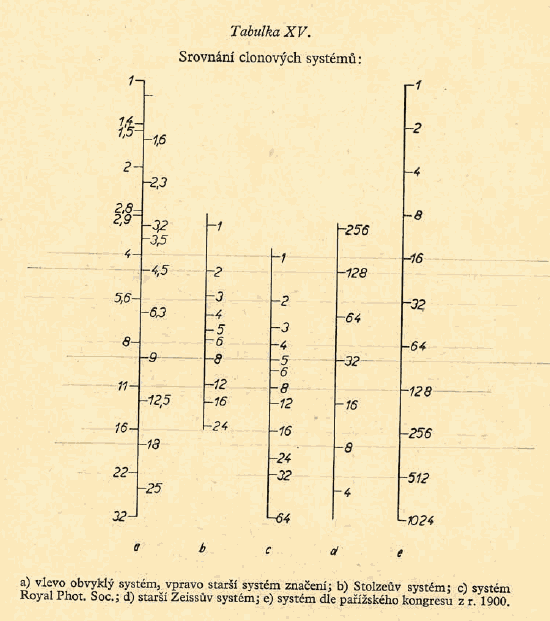
a) standard system (currently used values are on the left, older scale is on the right)
b) Stolze's system
c) system of Royal Phot. Soc.
d) old Zeiss's system
e) system of Paris congress 1900
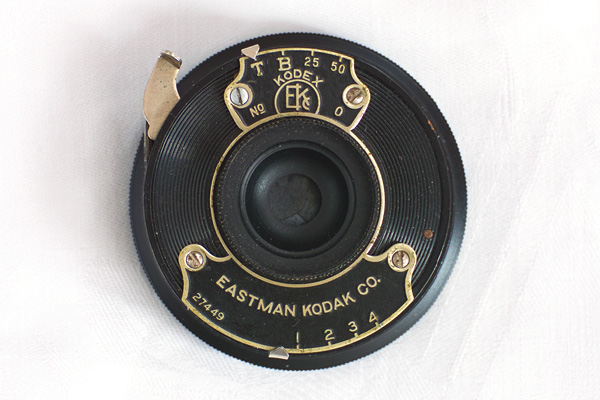
I think the list isn't complete, e.g. Kodak used its own values:
_________________
(almost) complete list of Helios lenses |
|
| Nach oben |
|
|
|
|
 Deutsch
 Español
 中文
 Magyar
 Русский
 日本語
 Français


