| Vorheriges Thema anzeigen :: Nächstes Thema anzeigen |
| Autor |
Nachricht |
Yossarian9 

Anmeldungsdatum: 30.12.2015
Beiträge: 2
Wohnort: Wisconsin, USA
|
 Verfasst am: Mi Dez 30, 2015 6:04 pm Titel: effective f-stop value |
|
Verfasst am: Mi Dez 30, 2015 6:04 pm Titel: effective f-stop value |
|
|
Yossarian9 wrote:
If one is using a medium-format lens (Mamiya 645 55mm F2. with an adapter (Photodiox Pro) on a Nikon DSLR (D7200) ...
Do the F-stop values represent the same?
In other words, the Mamiya lens is much bigger. the F2.8 in medium format is a larger window of light than a native Nikon lens at F2.8.
So is an F-stop of 2.8 in medium format, effectively something akin to an F1.8 on Nikon??
Appreciate your thoughts.
Yossarian. |
|
| Nach oben |
|
 |
dan_


Anmeldungsdatum: 05.12.2012
Beiträge: 1070
Wohnort: Romania
Expire: 2016-12-19
|
Verfasst am: Mi Dez 30, 2015 6:59 pm Titel: |
|
Verfasst am: Mi Dez 30, 2015 6:59 pm Titel: |
|
|
dan_ wrote:
The f-stops are the same regardless of the format on wich the lens is used (lens-depend, not camere/format-depend).
f-stop = focal length/diameter of thr entrance pupil of the lens(= diameter of the image of the diaphragm as it can be seen through the front of the lens). |
|
| Nach oben |
|
|
calvin83


Anmeldungsdatum: 12.04.2009
Beiträge: 7740
Wohnort: Hong Kong
|
Verfasst am: Mi Dez 30, 2015 7:02 pm Titel: |
|
Verfasst am: Mi Dez 30, 2015 7:02 pm Titel: |
|
|
calvin83 wrote:
The F stop value will not be changed as it is the property of a lens. The main reason why medium format lens is biggest is to get a large are of illumination/image circle.
_________________
The best lens is the one you have with you.
https://lensfever.com/
https://www.instagram.com/_lens_fever/ |
|
| Nach oben |
|
|
Yossarian9
Anmeldungsdatum: 30.12.2015
Beiträge: 2
Wohnort: Wisconsin, USA
|
Verfasst am: Mi Dez 30, 2015 7:21 pm Titel: effective f |
|
Verfasst am: Mi Dez 30, 2015 7:21 pm Titel: effective f |
|
|
Yossarian9 wrote:
Thats why I am asking about EFFECTIVE F-stop value... from the camera's sensor perspective.
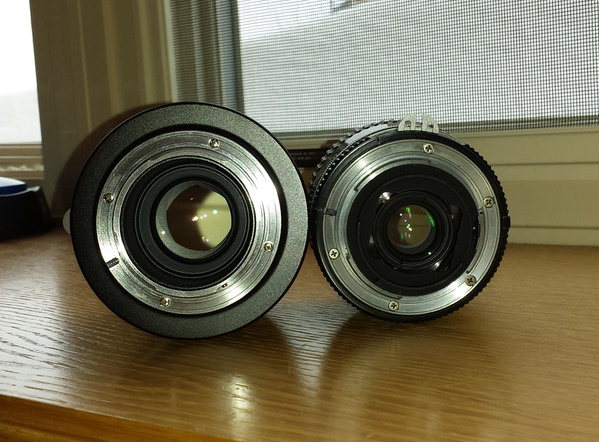
Look at this picture. both are 55mm at F/4. obviously the one on the left is the medium format.
To me the medium F/4 is bigger, and therefore will get more light to the sensor.
Am I thinking about this wrong?
Mostly, just want to know if the F2.8 medium format lens would be as good in low-light as, say, a nikon F1.8.
I suppose shooting the two would be way to find out.
 [/img] |
|
| Nach oben |
|
|
SXR_Mark

Anmeldungsdatum: 12.06.2010
Beiträge: 506
Wohnort: England
|
Verfasst am: Mi Dez 30, 2015 8:58 pm Titel: |
|
Verfasst am: Mi Dez 30, 2015 8:58 pm Titel: |
|
|
SXR_Mark wrote:
The density of the light (number of photons per unit area) will be the same for the two lenses when operating with the same F-stop (but see note below). The medium format lens transmits more light in total but images it to a larger area. The light that is received by the DSLR sensor will be the same whichever lens is used. The exposure is determined by the light density not the total amount of light.
NB. Strictly speaking, this is true for lenses of the same T-stop value. Lenses with the same F-stop will not, in general, have the same transmission since the F-stop is a geometric value that does not take into account the light lost at each glass to air boundary in the lens (absorption losses are usually negligible). A complicated lens, even with state-of-the-art AR coatings will still have a T-stop somewhat different to the F-stop value.
_________________
Olympus OM-D E-M1 for everything |
|
| Nach oben |
|
|
Gerald

Anmeldungsdatum: 25.03.2014
Beiträge: 1292
Wohnort: Brazil
|
Verfasst am: Fr Jan 01, 2016 11:34 pm Titel: Re: effective f |
|
Verfasst am: Fr Jan 01, 2016 11:34 pm Titel: Re: effective f |
|
|
Gerald wrote:
| Yossarian9 hat folgendes geschrieben:: |
Thats why I am asking about EFFECTIVE F-stop value... from the camera's sensor perspective.
Look at this picture. both are 55mm at F/4. obviously the one on the left is the medium format.
To me the medium F/4 is bigger, and therefore will get more light to the sensor.
Am I thinking about this wrong?
Mostly, just want to know if the F2.8 medium format lens would be as good in low-light as, say, a nikon F1.8.
I suppose shooting the two would be way to find out.
|
Notice you are seeing the exit pupils of the lenses. Yes, for the same F-number, the exit pupils may have different dimensions and be at different distances from the focal plane. However, if you look at the entrance pupils at the other side of the lenses, their diameters should be the same, no matter what type of lens.
_________________
If raindrops were perfect lenses, the rainbow did not exist. |
|
| Nach oben |
|
|
dan_
Anmeldungsdatum: 05.12.2012
Beiträge: 1070
Wohnort: Romania
Expire: 2016-12-19
|
Verfasst am: Fr Jan 01, 2016 11:57 pm Titel: |
|
Verfasst am: Fr Jan 01, 2016 11:57 pm Titel: |
|
|
dan_ wrote:
Nikon 1.8 lens will be better in low light than Mamiya 2.8. Any 1.8 lens will be better in low light than any 2.8 lens, regardless of the format they are designed for.
Read carefully the wiki article about f-number:
https://en.wikipedia.org/wiki/F-number
Both SXR_Mark and Gerald are speaking about 2 lenses with the same f-number, not about comparing your Nikon f/1.8 with a medium format f/2.8 lens, as you asked. |
|
| Nach oben |
|
|
visualopsins

Anmeldungsdatum: 05.03.2009
Beiträge: 11698
Wohnort: California
Expire: 2027-07-11
|
Verfasst am: Sa Jan 02, 2016 1:23 am Titel: |
|
Verfasst am: Sa Jan 02, 2016 1:23 am Titel: |
|
|
visualopsins wrote:
Lens made for medium format needs a bigger hole to let in the extra light needed to cover the area bigger than 24x36mm.
Learning about T-stop and F-stop difference might help here...
| Gerald hat folgendes geschrieben:: |
| ... if you look at the entrance pupils at the other side of the lenses, their diameters should be the same, no matter what type of lens. |
Huh? I don't think so...
_________________
☮☮☮☮☮☮☮☮☮☮☮☮☮☮☮☮☮☮☮☮☮☮☮☮☮☮☮☮☮☮☮☮ like attracts like! ☮☮☮☮☮☮☮☮☮☮☮☮☮☮☮☮☮☮☮☮☮☮☮☮☮☮☮☮☮☮☮☮
Cameras: Sony ILCE-7RM2, Spotmatics II, F, and ESII, Nikon P4
Lenses:
M42 Asahi Optical Co., Takumar 1:4 f=35mm, 1:2 f=58mm (Sonnar), 1:2.4 f=58mm (Heliar), 1:2.2 f=55mm (Gaussian), 1:2.8 f=105mm (Model I), 1:2.8/105 (Model II), 1:5.6/200, Tele-Takumar 1:5.6/200, 1:6.3/300, Macro-Takumar 1:4/50, Auto-Takumar 1:2.3 f=35, 1:1.8 f=55mm, 1:2.2 f=55mm, Super-TAKUMAR 1:3.5/28 (fat), 1:2/35 (Fat), 1:1.4/50 (8-element), Super-Multi-Coated Fisheye-TAKUMAR 1:4/17, Super-Multi-Coated TAKUMAR 1:4.5/20, 1:3.5/24, 1:3.5/28, 1:2/35, 1:3.5/35, 1:1.8/85, 1:1.9/85 1:2.8/105, 1:3.5/135, 1:2.5/135 (II), 1:4/150, 1:4/200, 1:4/300, 1:4.5/500, Super-Multi-Coated Macro-TAKUMAR 1:4/50, 1:4/100, Super-Multi-Coated Bellows-TAKUMAR 1:4/100, SMC TAKUMAR 1:1.4/50, 1:1.8/55
M42 Carl Zeiss Jena Flektogon 2.4/35
Contax Carl Zeiss Vario-Sonnar T* 28-70mm F3.5-4.5
Pentax K-mount SMC PENTAX-A ZOOM 1:3.5 35~105mm, SMC PENTAX ZOOM 1:4 45~125mm
Nikon Micro-NIKKOR-P-C Auto 1:3.5 f=55mm, NIKKOR-P Auto 105mm f/2.5 Pre-AI (Sonnar), Micro-NIKKOR 105mm 1:4 AI, NIKKOR AI-S 35-135mm f/3,5-4,5
Solinon 1:5.6/18 ASPH.
Tamron SP 17mm f/3.5 (51B), Tamron SP 17mm f/3.5 (151B), SP 500mm f/8 (55BB), SP 70-210mm f/3.5 (19AH)
Vivitar 100mm 1:2.8 MC 1:1 Macro Telephoto (Kiron)
|
|
| Nach oben |
|
|
|
|
|
Du kannst keine Beiträge in dieses Forum schreiben.
Du kannst auf Beiträge in diesem Forum nicht antworten.
Du kannst deine Beiträge in diesem Forum nicht bearbeiten.
Du kannst deine Beiträge in diesem Forum nicht löschen.
Du kannst an Umfragen in diesem Forum nicht mitmachen.
|
 Deutsch
 Español
 中文
 Magyar
 Русский
 日本語
 Français


