| Vorheriges Thema anzeigen :: Nächstes Thema anzeigen |
| Autor |
Nachricht |
shauttra 


Anmeldungsdatum: 17.11.2009
Beiträge: 778
Wohnort: Latvia
|
 Verfasst am: Di Feb 22, 2011 9:35 pm Titel: Astro Pano Zenitar 16/2.8 |
|
Verfasst am: Di Feb 22, 2011 9:35 pm Titel: Astro Pano Zenitar 16/2.8 |
|
|
shauttra wrote:
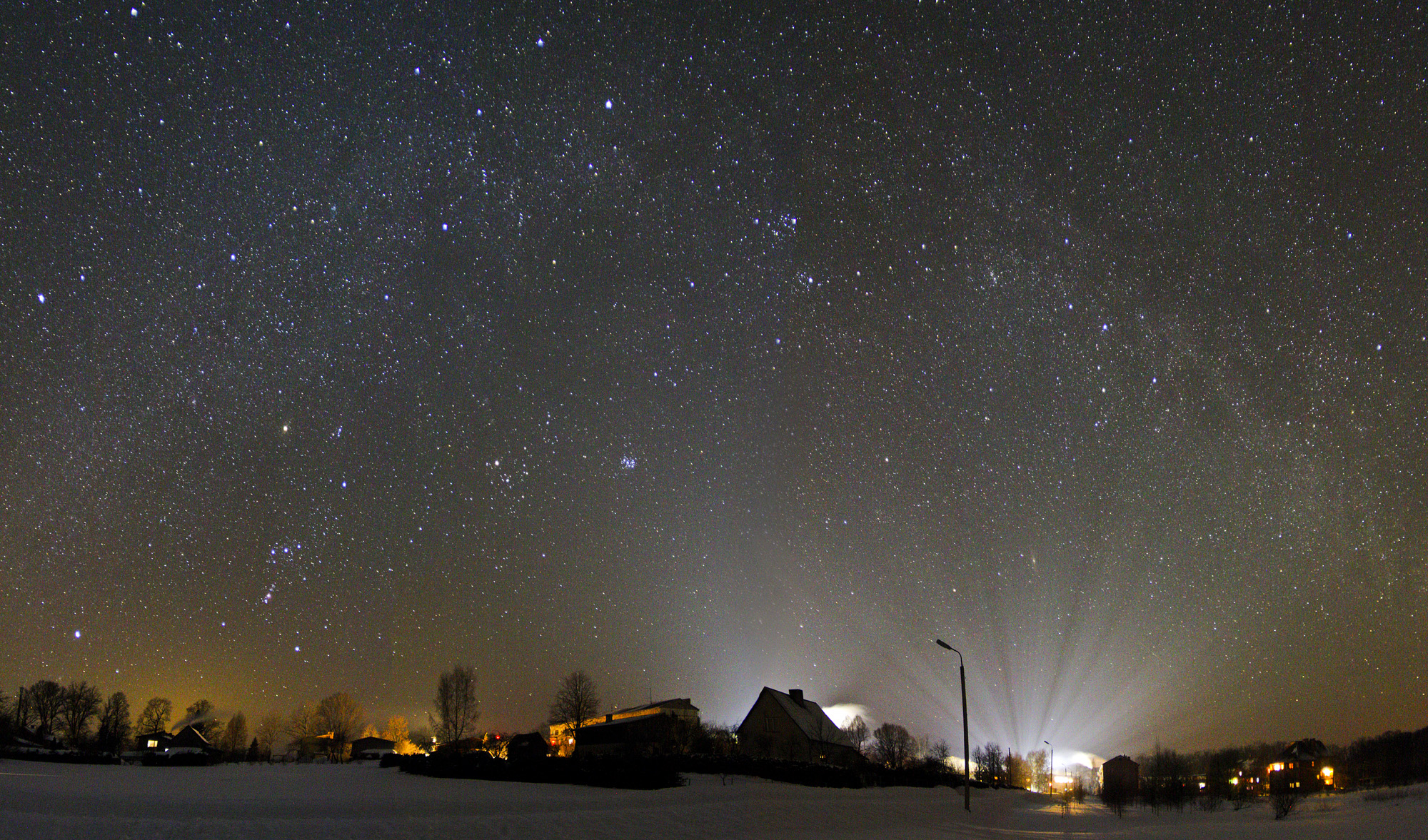
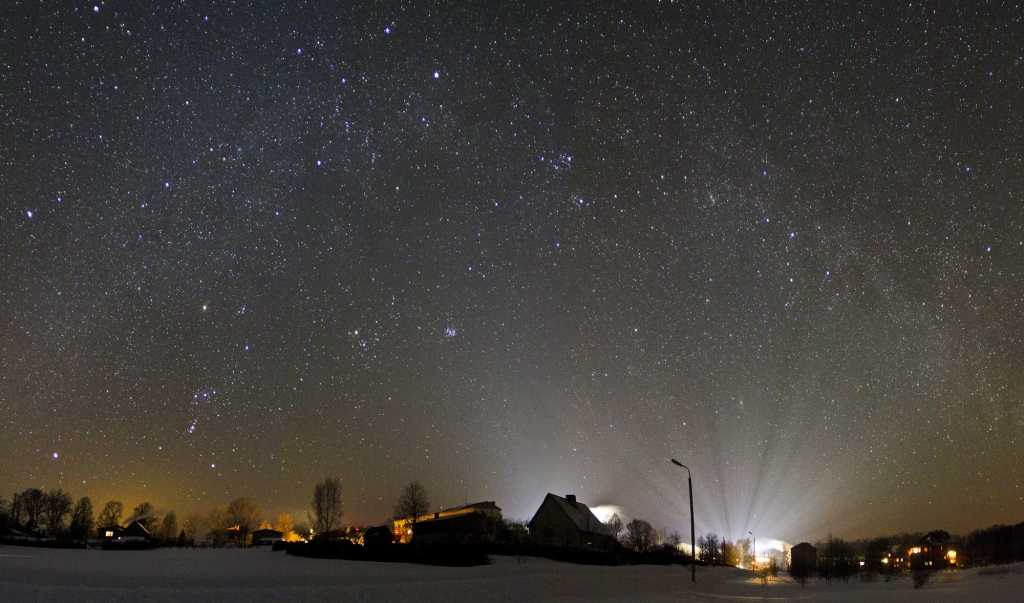
A part of my aurora hunting walk in my village.
Stacked from 5 vertical images. There is still visible stiching places.
ISO 3200, 30 sec, 16mm, f2.8
No auroras 
_________________
Mto-1000, Tair-3, Auto Exaktar 135mm 2,8, Samyang 14mm 2.8,
Jupiter 37A, Carl Zeiss Sonnar 135/3.5,
Helios-44, Mir-1, Revuenon 50/1.4,
Carl Zeiss Pancolar 50/1.8, Samyang 24/1.4, Auto Vivitar 35/2.8
www.radosi.lv
http://shauttra.blogspot.com |
|
| Nach oben |
|
 |
arhi_tectu1


Anmeldungsdatum: 09.02.2009
Beiträge: 315
|
Verfasst am: Di Feb 22, 2011 9:44 pm Titel: |
|
Verfasst am: Di Feb 22, 2011 9:44 pm Titel: |
|
|
arhi_tectu1 wrote:
congratulation very good photo (you will get lucky eventually )
Regards
Catalin
_________________
MF- CZJ 180/2.8@CZJ 50/2.8@Contax CZ 50/1.4@Contax CZ 135/2.8@Nikkor P 180/2.8@Helios 44@Mir 37/2.8@Industar 50/3.5@Pentacon 28/2.8@Pentacon 300/4
AF- Canon 70-200/4L@Canon 60/2.8Macro@Tokina 11-16/2.8
Camera Canon 40D |
|
| Nach oben |
|
|
Spotmatic

Anmeldungsdatum: 18.08.2008
Beiträge: 4045
Wohnort: Netherlands
|
Verfasst am: Di Feb 22, 2011 9:46 pm Titel: |
|
Verfasst am: Di Feb 22, 2011 9:46 pm Titel: |
|
|
Spotmatic wrote:
I clicked on the picture and wow, what a starry sky! You are a very talented photographer, I'm happy to have you among us
_________________
Peter - Moderator
Pentax K-5 + Pentax 645 + Canon 5D + Bessa RF 10,5cm Heliar, and a 'little' bag full of MF lenses. The lens list is * here *.
My fast 80s: Asahi-Kogaku Takumar 83mm f/1.9 - Super-Takumar 85mm f/1.9 - FA 77mm f/1.8 Limited - Cyclop 85/1.5 (Helios-40 innards) - Komura 80mm f/1.8 - Meyer Görlitz Primoplan 7,5cm 1:1.9 - Carl Zeiss Jena 80mm f/1.8 Pancolar - Canon 85mm f/1.8 S.S.C. - Canon 85mm f/1.2 S.S.C. Aspherical |
|
| Nach oben |
|
|
shauttra
Anmeldungsdatum: 17.11.2009
Beiträge: 778
Wohnort: Latvia
|
Verfasst am: Di Feb 22, 2011 9:46 pm Titel: |
|
Verfasst am: Di Feb 22, 2011 9:46 pm Titel: |
|
|
shauttra wrote:
| arhi_tectu1 hat folgendes geschrieben:: |
congratulation very good photo (you will get lucky eventually )
Regards
Catalin |
Thanks!
Everything is yet to come
_________________
Mto-1000, Tair-3, Auto Exaktar 135mm 2,8, Samyang 14mm 2.8,
Jupiter 37A, Carl Zeiss Sonnar 135/3.5,
Helios-44, Mir-1, Revuenon 50/1.4,
Carl Zeiss Pancolar 50/1.8, Samyang 24/1.4, Auto Vivitar 35/2.8
www.radosi.lv
http://shauttra.blogspot.com |
|
| Nach oben |
|
|
shauttra
Anmeldungsdatum: 17.11.2009
Beiträge: 778
Wohnort: Latvia
|
Verfasst am: Di Feb 22, 2011 9:49 pm Titel: |
|
Verfasst am: Di Feb 22, 2011 9:49 pm Titel: |
|
|
shauttra wrote:
| Spotmatic hat folgendes geschrieben:: |
| I clicked on the picture and wow, what a starry sky! You are a very talented photographer, I'm happy to have you among us |
I am delighted to be here There is the best company!
_________________
Mto-1000, Tair-3, Auto Exaktar 135mm 2,8, Samyang 14mm 2.8,
Jupiter 37A, Carl Zeiss Sonnar 135/3.5,
Helios-44, Mir-1, Revuenon 50/1.4,
Carl Zeiss Pancolar 50/1.8, Samyang 24/1.4, Auto Vivitar 35/2.8
www.radosi.lv
http://shauttra.blogspot.com |
|
| Nach oben |
|
|
Attila

Anmeldungsdatum: 24.02.2007
Beiträge: 58002
Expire: 2025-11-18
|
Verfasst am: Di Feb 22, 2011 9:50 pm Titel: |
|
Verfasst am: Di Feb 22, 2011 9:50 pm Titel: |
|
|
Attila wrote:
| Spotmatic hat folgendes geschrieben:: |
| I clicked on the picture and wow, what a starry sky! You are a very talented photographer, I'm happy to have you among us |
+10 |
|
| Nach oben |
|
|
kds315*

Anmeldungsdatum: 12.03.2008
Beiträge: 16911
Wohnort: Kehl, Germany
Expire: 2021-03-09
|
Verfasst am: Di Feb 22, 2011 10:08 pm Titel: |
|
Verfasst am: Di Feb 22, 2011 10:08 pm Titel: |
|
|
kds315* wrote:
Very well done (even without aurora)!!
_________________
Klaus - Admin
"S'il vient a point, me souviendra" [Thomas Bohier (1460-1523)]
http://www.macrolenses.de for macro and special lens info
http://www.pbase.com/kds315/uv_photos for UV Images and lens/filter info
https://www.flickr.com/photos/kds315/albums my albums using various lenses
http://photographyoftheinvisibleworld.blogspot.com/ my UV BLOG
http://www.travelmeetsfood.com/blog Food + Travel BLOG
https://galeriafotografia.com Architecture + Drone photography
Currently most FAV lens(es):
X80QF f3.2/80mm
Hypergon f11/26mm
ELCAN UV f5.6/52mm
Zeiss UV-Planar f4/60mm
Zeiss UV-Planar f2/62mm
Lomo Уфар-12 f2.5/41mm
Lomo Зуфар-2 f4.0/350mm
Lomo ZIKAR-1A f1.2/100mm
Nikon UV Nikkor f4.5/105mm
Zeiss UV-Sonnar f4.3/105mm
CERCO UV-VIS-NIR f1.8/45mm
CERCO UV-VIS-NIR f4.1/94mm
CERCO UV-VIS-NIR f2.8/100mm
Steinheil Quarzobjektiv f1.8/50mm
Pentax Quartz Takumar f3.5/85mm
Carl Zeiss Jena UV-Objektiv f4/60mm
NYE OPTICAL Lyman-Alpha II f1.1/90mm
NYE OPTICAL Lyman-Alpha I f2.8/200mm
COASTAL OPTICS f4/60mm UV-VIS-IR Apo
COASTAL OPTICS f4.5/105mm UV-Micro-Apo
Pentax Ultra-Achromatic Takumar f4.5/85mm
Pentax Ultra-Achromatic Takumar f5.6/300mm
Rodenstock UV-Rodagon f5.6/60mm + 105mm + 150mm
|
|
| Nach oben |
|
|
Scheimpflug
Anmeldungsdatum: 06.02.2010
Beiträge: 1888
Wohnort: New Zealand / USA
Expire: 2011-11-18
|
Verfasst am: Mi Feb 23, 2011 12:28 am Titel: Re: Astro Pano Zenitar 16/2.8 |
|
Verfasst am: Mi Feb 23, 2011 12:28 am Titel: Re: Astro Pano Zenitar 16/2.8 |
|
|
Scheimpflug wrote:
| shauttra hat folgendes geschrieben:: |
Stacked from 5 vertical images. There is still visible stiching places.
ISO 3200, 30 sec, 16mm, f2.8 |
High-ISO stitching can be problematic, and sometimes stitching them can be counter-intuitive.
The biggest giveaway for the stitch lines is banding, and the reason you get banding is because the stitchers automatically blend a somewhat wide region between adjacent images to mask the stitch line and balance any exposure differences.
With normal images this works great the majority of the time. What causes problems with high-ISO images is that this blending is effectively layering & averaging images, which is a very effective method for reducing random image noise. So you have a large image with normal high-ISO noise, but with bands which have less noise.
So the trick is to adjust the stitching settings so that the blend width is very very small, just a few pixels, or perhaps even zero so that the images are hard-cut. This also requires that the images be well-corrected for exposure, color, and vignetting... and very precisely aligned so that the edges match, as the blend region won't hide these problems.
Hope that helps. Your photo is fantastic by the way. 
_________________
Sigma DP1, Nikon D40 (hers  ), Polaroid x530, Pentax P30t, Pentax P50, (P30t/P50 K-A to Nikon F body mount conversion)
Nikon: 18-55/3.5-5.6 "G ED II DX" (F) Soligor: 28/2.8 (FL->F converted), 135/3.5 (F), 3x TC (F, modified) Kalimar: 28-85/3.5 (F)
Vivitar: 70-210/2.8-4.0 Version 3 (F), Tele 500/6.3 Preset (F), 19/3.8 (F) Minolta: 300/5.6 (SR/MC/MD pending F conversion)
Tamron: 28/2.8 (Adaptall) Panagor: 28/2.5 (FD) Aetna: 300/5.6 (F) Osawa: MC 28/2.8 (F)
Vintage Lenses: Dallmeyer: 1940s A.M. 14in 356mm f4 (ULF->M42) 1930s Adon Telephoto Taylor, Taylor & Hobson: 1880s Rapid Rectilinear 8 1/2 x 6 1/2 11.31in f/8 (LF->?)
Parts Lenses: Nikon 35-135/3.5-4.5 (F), Sigma 70-210/4.5 (F), Nikon 50/1.8 Series E (F) |
|
| Nach oben |
|
|
shauttra
Anmeldungsdatum: 17.11.2009
Beiträge: 778
Wohnort: Latvia
|
Verfasst am: Mi Feb 23, 2011 5:43 am Titel: Re: Astro Pano Zenitar 16/2.8 |
|
Verfasst am: Mi Feb 23, 2011 5:43 am Titel: Re: Astro Pano Zenitar 16/2.8 |
|
|
shauttra wrote:
| Scheimpflug hat folgendes geschrieben:: |
| shauttra hat folgendes geschrieben:: |
Stacked from 5 vertical images. There is still visible stiching places.
ISO 3200, 30 sec, 16mm, f2.8 |
High-ISO stitching can be problematic, and sometimes stitching them can be counter-intuitive.
The biggest giveaway for the stitch lines is banding, and the reason you get banding is because the stitchers automatically blend a somewhat wide region between adjacent images to mask the stitch line and balance any exposure differences.
With normal images this works great the majority of the time. What causes problems with high-ISO images is that this blending is effectively layering & averaging images, which is a very effective method for reducing random image noise. So you have a large image with normal high-ISO noise, but with bands which have less noise.
So the trick is to adjust the stitching settings so that the blend width is very very small, just a few pixels, or perhaps even zero so that the images are hard-cut. This also requires that the images be well-corrected for exposure, color, and vignetting... and very precisely aligned so that the edges match, as the blend region won't hide these problems.
Hope that helps. Your photo is fantastic by the way. |
Lot of new info!
Thanks!!
_________________
Mto-1000, Tair-3, Auto Exaktar 135mm 2,8, Samyang 14mm 2.8,
Jupiter 37A, Carl Zeiss Sonnar 135/3.5,
Helios-44, Mir-1, Revuenon 50/1.4,
Carl Zeiss Pancolar 50/1.8, Samyang 24/1.4, Auto Vivitar 35/2.8
www.radosi.lv
http://shauttra.blogspot.com |
|
| Nach oben |
|
|
|
|
|
Du kannst keine Beiträge in dieses Forum schreiben.
Du kannst auf Beiträge in diesem Forum nicht antworten.
Du kannst deine Beiträge in diesem Forum nicht bearbeiten.
Du kannst deine Beiträge in diesem Forum nicht löschen.
Du kannst an Umfragen in diesem Forum nicht mitmachen.
|
 Deutsch
 Español
 中文
 Magyar
 Русский
 日本語
 Français