| Vorheriges Thema anzeigen :: Nächstes Thema anzeigen |
| Autor |
Nachricht |
iangreenhalgh1 

Anmeldungsdatum: 18.03.2011
Beiträge: 15679
Expire: 2014-01-07
|
 Verfasst am: So Jun 12, 2022 7:06 pm Titel: |
|
Verfasst am: So Jun 12, 2022 7:06 pm Titel: |
|
|
iangreenhalgh1 wrote:
Yes, I am using most of them on M4/3 ofor that reason, however, some of them do cover larger sizes. The chips used in DLP projectors come in a range of sizes, the smaller ones are labelled 0.55", the larger ones 0.9", 0.63" is a common size. These sizes don't easily relate to sensor sizes in cameras though, the 0.63†chip has a 16mm diagonal, whereas a 1" camera sensor such as the Nikon CX has a 15.86mm diagonal. The 0.7" DLP chip has a 22.2mm diagonal which is close to a micro 4/3 sensor is size (21.6mm diagonal). Of course, the actual usable image circle of these lenses can only be discovered through trying them, some throw a much larger image circle than you would expect, but only a postion of it is of a usable level of definition. Here's an example of such a lens on a M4/3 camera, the outer part of the image is smeary so this lens is only suitable for a 1" sensor.


_________________
I don't care who designed it, who made it or what country it comes from - I just enjoy using it! |
|
| Nach oben |
|
 |
iangreenhalgh1
Anmeldungsdatum: 18.03.2011
Beiträge: 15679
Expire: 2014-01-07
|
Verfasst am: So Jun 12, 2022 7:16 pm Titel: |
|
Verfasst am: So Jun 12, 2022 7:16 pm Titel: |
|
|
iangreenhalgh1 wrote:
On the macro thing, I temporarily mounted the lens in a long helicod that allows it to focus very close, so inevitably, I tried some macro shots with it.
When used for macro shots, the lens still has good resolution but this is masked by aberrations, which is to be expected using the lens so far outside it's intended magnification range.
Here's a couple of macro shots so you can see what I mean - there is fine detail if you look closely, to go closer than this into more extreme macro is not worthwhile with this lens as the aberrations become too severe making focussing very hard and the images produced rather glowy.


At the sort of magnification it was designed to work at, it's much better behaved:

_________________
I don't care who designed it, who made it or what country it comes from - I just enjoy using it! |
|
| Nach oben |
|
|
simple.joy

Anmeldungsdatum: 30.05.2022
Beiträge: 954
|
Verfasst am: So Jun 12, 2022 10:45 pm Titel: |
|
Verfasst am: So Jun 12, 2022 10:45 pm Titel: |
|
|
simple.joy wrote:
| iangreenhalgh1 hat folgendes geschrieben:: |
On the macro thing, I temporarily mounted the lens in a long helicod that allows it to focus very close, so inevitably, I tried some macro shots with it.
When used for macro shots, the lens still has good resolution but this is masked by aberrations, which is to be expected using the lens so far outside it's intended magnification range.
Here's a couple of macro shots so you can see what I mean - there is fine detail if you look closely, to go closer than this into more extreme macro is not worthwhile with this lens as the aberrations become too severe making focussing very hard and the images produced rather glowy.
|
I like that one, looks great!
I thought of another quite unusual lens (already mentioned in another thread) which absolutely fits the theme of 'Selecting for the look' in my opinion:
It's an Agfa "M. 3525 6/3" lens (which is the serial number, and I suspect this might be some kind of prototype lens, because it looks like this:
 A lens? Basically just a cylinder by simple.joy, on Flickr
I'm pretty sure it's a triplet, around 2.5 cm / 1 inch in diameter and the unassuming ring on it moves a 10-bladed circular aperture. I would guess that it has a maximum aperture of around F 2.8 with a focal length of roughly 50 mm. It doesn't have a mount, as the thread on its barrel has an unusual thread pitch, that looks rather like a remnant of production. It's possible that it is a prototype for a triplet enlarging lens Agfa patented in 1958 (but as far as I'm aware never went into production).
This lens was sold as "broken/for parts" along a couple of similar lenses. It's quite possible that it sat there for a decade or more without anyone showing the slightest interest in it and it might as well have been discarded along the way. Turned out, it wasn't broken at all, just had a tiny problem which took 5 minutes (for a technically unskilled person like me) to fix. These are a couple of the shots I used it for since then:
 Pearly gates by simple.joy, on Flickr
 No one else wanted it... now it's Robert‘s! by simple.joy, on Flickr
 Rad color! by simple.joy, on Flickr
 Green light for takeoff by simple.joy, on Flickr
 Major Second by simple.joy, on Flickr
This lens certainly has it's flaws as well, but I feel like it's capable of creating a unique, beautiful rendering and enough sharpness in the macro and close-up range to compete with some of the best lenses I own. It's these moments where I feel like the effort and time spent in search of the gems among these unusual, seemingly unimpressive lenses, was well worth it.
_________________
---
Manual lens enthusiast
https://www.flickr.com/photos/simple_joy/ |
|
| Nach oben |
|
|
eggplant

Anmeldungsdatum: 27.05.2020
Beiträge: 517
|
Verfasst am: So Jun 12, 2022 11:01 pm Titel: |
|
Verfasst am: So Jun 12, 2022 11:01 pm Titel: |
|
|
eggplant wrote:
| iangreenhalgh1 hat folgendes geschrieben:: |
Yes, I am using most of them on M4/3 ofor that reason, however, some of them do cover larger sizes. The chips used in DLP projectors come in a range of sizes, the smaller ones are labelled 0.55", the larger ones 0.9", 0.63" is a common size. These sizes don't easily relate to sensor sizes in cameras though, the 0.63†chip has a 16mm diagonal, whereas a 1" camera sensor such as the Nikon CX has a 15.86mm diagonal. The 0.7" DLP chip has a 22.2mm diagonal which is close to a micro 4/3 sensor is size (21.6mm diagonal).
|
That's curious- any reason you might think that's the case? Am I missing something?
It is interesting how 'well behaved' it is at normal distances wide open. That's very impressive performance across the field but it might be cropped to 1 inch sensor. Even still very good- if you told me it was native M43 lens I would believe you.
This leaves me ever more curious where mine, which clearly do APS-C with no discernable edge aberrations, come from.
I had some other thoughts but I forgot them. Oh well. You can take a look at the one I will be eventually reviewing, which for me has the record for the most bulbous element I've ever seen- and note, not a fisheye:

The eagle-eyed amongst you will spot how the rim of the lens is curved by the front element so extremely..  |
|
| Nach oben |
|
|
iangreenhalgh1
Anmeldungsdatum: 18.03.2011
Beiträge: 15679
Expire: 2014-01-07
|
Verfasst am: So Jun 12, 2022 11:04 pm Titel: |
|
Verfasst am: So Jun 12, 2022 11:04 pm Titel: |
|
|
iangreenhalgh1 wrote:
That little Agfa is a very impressive lens, that fly image shows that. It's definitely got a lot of resolution. I suppose it's intended for some sort of industrial machine, who knows.
I have a collection of similar esoteric tiny lenses I use for extreme macro, I'll have to get them out and take some pics then share some info on them.
_________________
I don't care who designed it, who made it or what country it comes from - I just enjoy using it! |
|
| Nach oben |
|
|
iangreenhalgh1
Anmeldungsdatum: 18.03.2011
Beiträge: 15679
Expire: 2014-01-07
|
Verfasst am: So Jun 12, 2022 11:35 pm Titel: |
|
Verfasst am: So Jun 12, 2022 11:35 pm Titel: |
|
|
iangreenhalgh1 wrote:
| eggplant hat folgendes geschrieben:: |
| iangreenhalgh1 hat folgendes geschrieben:: |
Yes, I am using most of them on M4/3 ofor that reason, however, some of them do cover larger sizes. The chips used in DLP projectors come in a range of sizes, the smaller ones are labelled 0.55", the larger ones 0.9", 0.63" is a common size. These sizes don't easily relate to sensor sizes in cameras though, the 0.63†chip has a 16mm diagonal, whereas a 1" camera sensor such as the Nikon CX has a 15.86mm diagonal. The 0.7" DLP chip has a 22.2mm diagonal which is close to a micro 4/3 sensor is size (21.6mm diagonal).
|
That's curious- any reason you might think that's the case? Am I missing something?
It is interesting how 'well behaved' it is at normal distances wide open. That's very impressive performance across the field but it might be cropped to 1 inch sensor. Even still very good- if you told me it was native M43 lens I would believe you.
This leaves me ever more curious where mine, which clearly do APS-C with no discernable edge aberrations, come from.
I had some other thoughts but I forgot them. Oh well. You can take a look at the one I will be eventually reviewing, which for me has the record for the most bulbous element I've ever seen- and note, not a fisheye:
The eagle-eyed amongst you will spot how the rim of the lens is curved by the front element so extremely.. |
All I meant about the chip sizes vs sensor sizes was that they don't use the same system of nomenclature so a 1" DLP chip is not the same size as a 1" camera sensor.
I think the largest projector chips I've seen were in the 1.1 to 1.3" range, which is probably what you rather large lens is for - they are interchangeable lenses for large projectors made by companies like Eiki, Barco, Sanyo, Epson & Christie, you see them in theatres, halls etc, they cost a lot of money - tens of thousands and the lenses are thousands too.
That is one hell of a bulbous front element, I've never seen one like that before, most ultra wide ones have an aspheric front that is flat in the centre. The drawback with those big lenses is the size & weight, because the projectors get very hot, the lenses are in very thick metal barrels - the walls can be 7-10mm thick just to have enough thermal mass, so adapting them to camera use might not be all that practical, it can surely be done, but the end result might be a bit on the cumbersome side. A friend with a lathe would be useful.
For comparison's sakes, here's two of my ultrawide DLP lenses - on the left with the big front element is the NEC 9.7mm, mounted for M4/3, no iris, it has very good IQ and is useful for architectural work. Next to it is the much smaller but even wider FOV lens from a Promethean projector, not sure what the specs are but I'm guessing it's about an 8mm focal length. This is the one that covers m4/3 but with smeary edges so is better used on a 1" sensor. I have a Nikon J1 so I'm going to put this lens in a barrel/mount for that camera instead.

Here's a shot with the Promethean lens, with the frame of the NEC 9.7mm superimposed to show how much wider the Promethean is - it's bloody wide, such a shame the outer part of the frame is smeary otherwise it would be great on M4/3

I took a couple of shots with the Promethean at the weekend, as you can see, the corners and edges are just not great on M4/3:

_________________
I don't care who designed it, who made it or what country it comes from - I just enjoy using it! |
|
| Nach oben |
|
|
eggplant
Anmeldungsdatum: 27.05.2020
Beiträge: 517
|
Verfasst am: Mo Jun 13, 2022 12:46 am Titel: |
|
Verfasst am: Mo Jun 13, 2022 12:46 am Titel: |
|
|
eggplant wrote:
| iangreenhalgh1 hat folgendes geschrieben:: |
All I meant about the chip sizes vs sensor sizes was that they don't use the same system of nomenclature so a 1" DLP chip is not the same size as a 1" camera sensor.
I think the largest projector chips I've seen were in the 1.1 to 1.3" range, which is probably what you rather large lens is for - they are interchangeable lenses for large projectors made by companies like Eiki, Barco, Sanyo, Epson & Christie, you see them in theatres, halls etc, they cost a lot of money - tens of thousands and the lenses are thousands too. |
Ah- I see. And yes, my next point would be half of these lenses need to support a shift function of some kind, so demand a larger image circle anyway. And I imagine uneven vignetting might not look good, particularly when you have no aperture control to reduce it.
| iangreenhalgh1 hat folgendes geschrieben:: |
That is one hell of a bulbous front element, I've never seen one like that before, most ultra wide ones have an aspheric front that is flat in the centre.
|
Yes, and arguably being able to produce aspherics affordably to make lenses smaller more impressive etc etc.
However, I don't even think that changes how difficult this on it's own might've been to produce, or to marvel at. Here is a 20p coin on the side... also note the element has managed to stay pretty unblemished (without cleaning it).
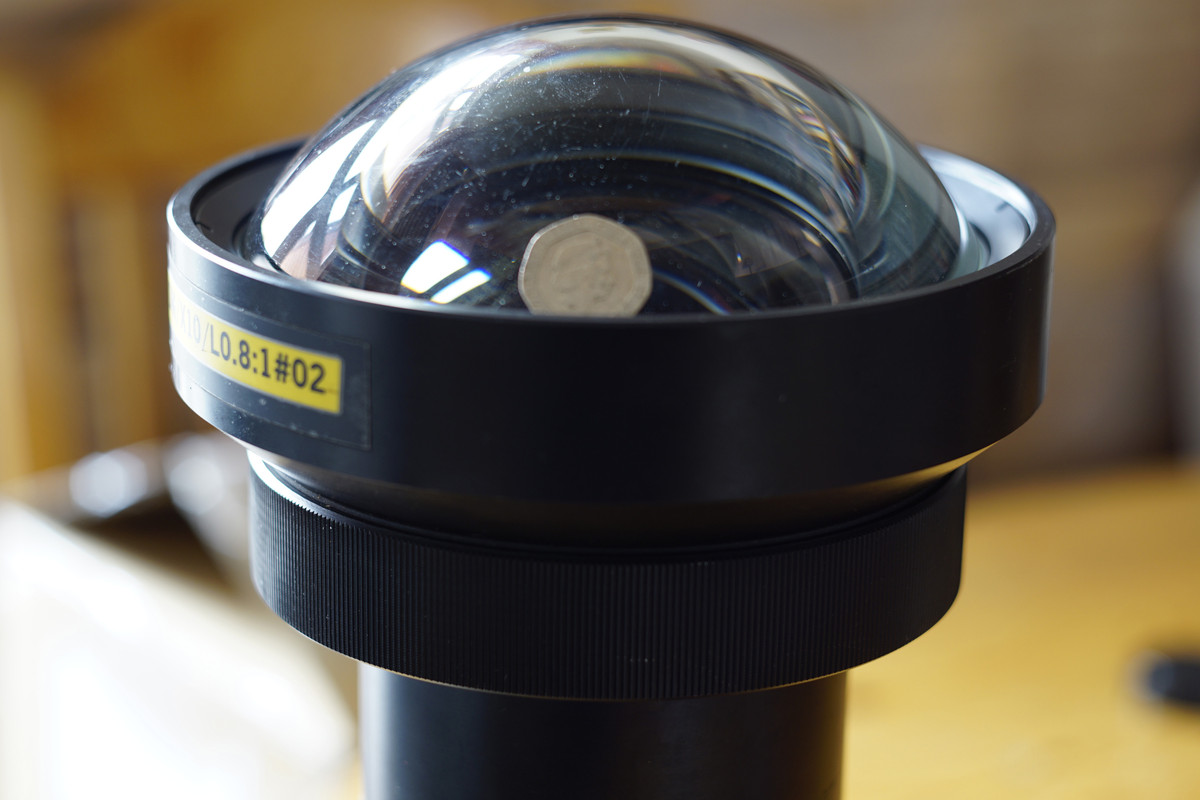
The lens has DM/X10/L0.8:1 written on it, and XGA on the box, and was able to identify it being for the Christie Roadie X10 Projector (and other Christie projectors of the same class)- discontinued Dec 2003.
As you can see the thing is bloody huge so even this bulbous lens wouldn't be too much trouble.

Resolution is 1024x768 but the higher specced projectors could be a bit higher. 2 cm DLP x 3 chip on the X10- any idea of sensor size? The image circle produced is APS-H sized.
The flange distance is quite long, more than Nikon F by about 20mm, so I would say it might explain the bulbous front element. But I'm pretty hesitant on pinning everything on flange distance alone.
The knurled collar behind the front element rotates to a hard stop, in either direction, but doesn't actually change anything. Not sure how a spherical lens would benefit from being able to be rotated freely either...
| iangreenhalgh1 hat folgendes geschrieben:: |
The drawback with those big lenses is the size & weight, because the projectors get very hot, the lenses are in very thick metal barrels - the walls can be 7-10mm thick just to have enough thermal mass, so adapting them to camera use might not be all that practical, it can surely be done, but the end result might be a bit on the cumbersome side. A friend with a lathe would be useful.
|
Yes I pretty much own it for amusement purposes, it is unusably heavy and doesn't offer much more speed or wideness than any other lens of it's class- which should, really, be expected...
I would be curious to disassemble it and the rear group looks as if it just unscrews, but it will not budge. Maybe a bit of heat required. Would love to see an optical diagram of it.
| iangreenhalgh1 hat folgendes geschrieben:: |
For comparison's sakes, here's two of my ultrawide DLP lenses - on the left with the big front element is the NEC 9.7mm, mounted for M4/3, no iris, it has very good IQ and is useful for architectural work. Next to it is the much smaller but even wider FOV lens from a Promethean projector, not sure what the specs are but I'm guessing it's about an 8mm focal length. This is the one that covers m4/3 but with smeary edges so is better used on a 1" sensor. I have a Nikon J1 so I'm going to put this lens in a barrel/mount for that camera instead.
|
I know you've at this point made a bunch of posts on these, so maybe too late for simple questions, but I do wonder where you find these on eBay for pennies, or what the idea of pennies is (which I hope doesn't sound rude)
I know I need to look beyond Cameras & Photography, usually the computing sections, I have had bad luck finding them cheaply at auction. I am going to guess they might come packaged with projectors, but that usually takes price to £25+.
Have seen a couple cheaper, lens-only, but never felt able to take the plunge. Yours do look like a lovely size though. Just not sure what I should be expecting. |
|
| Nach oben |
|
|
iangreenhalgh1
Anmeldungsdatum: 18.03.2011
Beiträge: 15679
Expire: 2014-01-07
|
Verfasst am: Mo Jun 13, 2022 12:57 am Titel: |
|
Verfasst am: Mo Jun 13, 2022 12:57 am Titel: |
|
|
iangreenhalgh1 wrote:
I expect that Roadie has large chips, probably 1.1", not sure what that equates to in actual dimensions, I'll see what I can find out tomorrow.
I very much understand and approve of owning a lens just for vicarious entertainment purposes and that huge bulbous bugger fits the profile perfectly!
I just buy decomissioned projectors, I only pay up to a fiver or so plus postage, usually the postage is more than the cost of the projector.
Just Google the projector name to find the manual and they always list the lens details in the specs section so you can pick out interesting sounding ones such as an f1.85 8.1mm.
Here's the last two projectors I bought.

_________________
I don't care who designed it, who made it or what country it comes from - I just enjoy using it! |
|
| Nach oben |
|
|
kds315*

Anmeldungsdatum: 12.03.2008
Beiträge: 16912
Wohnort: Kehl, Germany
Expire: 2021-03-09
|
Verfasst am: Mo Jun 13, 2022 5:08 am Titel: |
|
Verfasst am: Mo Jun 13, 2022 5:08 am Titel: |
|
|
kds315* wrote:
Superb images guys! 
IAN: stay away from such insulting personal comments please - you have again been warned...
_________________
Klaus - Admin
"S'il vient a point, me souviendra" [Thomas Bohier (1460-1523)]
http://www.macrolenses.de for macro and special lens info
http://www.pbase.com/kds315/uv_photos for UV Images and lens/filter info
https://www.flickr.com/photos/kds315/albums my albums using various lenses
http://photographyoftheinvisibleworld.blogspot.com/ my UV BLOG
http://www.travelmeetsfood.com/blog Food + Travel BLOG
https://galeriafotografia.com Architecture + Drone photography
Currently most FAV lens(es):
X80QF f3.2/80mm
Hypergon f11/26mm
ELCAN UV f5.6/52mm
Zeiss UV-Planar f4/60mm
Zeiss UV-Planar f2/62mm
Lomo Уфар-12 f2.5/41mm
Lomo Зуфар-2 f4.0/350mm
Lomo ZIKAR-1A f1.2/100mm
Nikon UV Nikkor f4.5/105mm
Zeiss UV-Sonnar f4.3/105mm
CERCO UV-VIS-NIR f1.8/45mm
CERCO UV-VIS-NIR f4.1/94mm
CERCO UV-VIS-NIR f2.8/100mm
Steinheil Quarzobjektiv f1.8/50mm
Pentax Quartz Takumar f3.5/85mm
Carl Zeiss Jena UV-Objektiv f4/60mm
NYE OPTICAL Lyman-Alpha II f1.1/90mm
NYE OPTICAL Lyman-Alpha I f2.8/200mm
COASTAL OPTICS f4/60mm UV-VIS-IR Apo
COASTAL OPTICS f4.5/105mm UV-Micro-Apo
Pentax Ultra-Achromatic Takumar f4.5/85mm
Pentax Ultra-Achromatic Takumar f5.6/300mm
Rodenstock UV-Rodagon f5.6/60mm + 105mm + 150mm
|
|
| Nach oben |
|
|
|
|
|
Du kannst keine Beiträge in dieses Forum schreiben.
Du kannst auf Beiträge in diesem Forum nicht antworten.
Du kannst deine Beiträge in diesem Forum nicht bearbeiten.
Du kannst deine Beiträge in diesem Forum nicht löschen.
Du kannst an Umfragen in diesem Forum nicht mitmachen.
|
 Deutsch
 Español
 中文
 Magyar
 Русский
 日本語
 Français